Pine needles, with their dense and often damp nature, present a formidable challenge for any outdoor cleanup. Unlike light, fluffy leaves, these stubborn needles tend to cling to surfaces, embed themselves in grass, and create thick, resistant mats. For homeowners and professionals alike, a standard leaf blower often falls short, leading to hours of frustrating and ineffective labor. This guide is crafted to help you navigate the landscape of heavy-duty leaf blowers, specifically those engineered to tackle the tenacity of pine needles, ensuring your yard cleanup is both efficient and thorough.
A robust leaf blower transforms the daunting task of clearing pine needles into a manageable chore. We’ll delve into the various types of blowers, their power sources, and the critical specifications that make a real difference when facing heavy debris. Whether you’re dealing with a small patch or a vast, needle-strewn property, understanding these tools is the first step toward reclaiming your outdoor spaces.
Overview of Leaf Blowers
A leaf blower is an essential outdoor power tool designed to push air at high speeds to move debris like leaves, grass clippings, and, crucially for our discussion, stubborn pine needles. What began as a modified agricultural sprayer in the mid-20th century has evolved into sophisticated machinery with diverse applications beyond just autumn cleanup, becoming a year-round staple for maintaining pristine outdoor environments.
Modern leaf blowers generally fall into three main categories based on their design: handheld, backpack, and walk-behind. Handheld blowers are lightweight and offer excellent maneuverability for smaller areas. Backpack models distribute weight across the user’s back, making them ideal for extended use over larger properties, providing a balance of power and comfort. Walk-behind blowers, often resembling small lawnmowers, are the most powerful and best suited for very large properties or commercial applications where maximum air volume is required to clear vast areas.
Classifying Leaf Blowers by Power Source
The choice of power source significantly impacts a leaf blower’s performance, maintenance, and environmental footprint. Each type offers distinct advantages and disadvantages, particularly when considering the demands of heavy-duty tasks like clearing pine needles.
Electric Leaf Blowers
Electric leaf blowers, available in corded and battery-powered variants, are often the go-to for homeowners seeking convenience and lower environmental impact. Corded electric blowers provide consistent power without the need for refueling or recharging, making them lightweight and easy to start. They are notably quieter than their gas counterparts and produce zero emissions during operation. However, their mobility is limited by the length of an extension cord, making them best suited for smaller yards or areas close to a power outlet. While generally less powerful than gas models, some high-end corded blowers offer impressive airflow for medium-duty tasks.
Gas Leaf Blowers
For tackling extensive areas and the most stubborn debris, gas-powered leaf blowers remain the champions of raw power and mobility. Their robust engines generate superior air speed (MPH) and air volume (CFM), making them highly effective against wet leaves, compacted debris, and dense layers of pine needles. Gas blowers offer unlimited runtime, provided you have fuel on hand, and are completely portable without the constraint of cords. However, these powerful machines come with trade-offs: they are significantly louder, produce exhaust emissions, are heavier, and require regular maintenance such as fuel mixing, oil changes, and air filter cleaning. Their noise levels can also be a concern in residential neighborhoods.
Battery Leaf Blowers
Battery-powered leaf blowers strike a compelling balance between the power of gas and the convenience of electric models. They offer cord-free mobility, are considerably quieter than gas blowers, and produce no direct emissions, making them environmentally friendlier. Modern lithium-ion battery technology has dramatically improved their power output and runtime, with many high-voltage (e.g., 56V, 60V, 80V) models now capable of handling challenging tasks, including moving stubborn pine needles. While their runtime is limited by battery capacity, interchangeable batteries allow for extended work sessions. The main considerations are the initial cost, which can be higher than corded electric, and the need to manage battery charging.
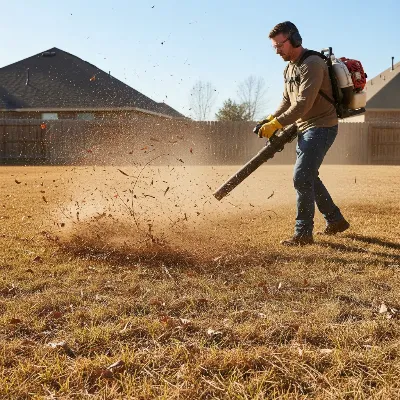 A powerful gas leaf blower in action, blowing a large pile of stubborn pine needles across a wide, open yard.
Detailed Comparison of Leaf Blower Types
Choosing the right leaf blower for heavy-duty tasks, especially with pine needles, involves weighing the pros and cons of each power type against your specific needs. The table below offers a quick comparison to help you make an informed decision.
| Feature | Corded Electric Leaf Blower | Battery Leaf Blower | Gas Leaf Blower |
|---|---|---|---|
| Power | Moderate to High | Moderate to Very High | Very High |
| Weight | Light | Light to Medium | Medium to Heavy (often backpack) |
| Noise Level | Low | Low to Moderate | High |
| Runtime | Unlimited (with power) | Limited (by battery charge) | Unlimited (with fuel) |
| Maintenance | Low | Low | High |
| Emissions | None | None | High |
| Mobility | Limited (by cord) | High | High |
| Ideal Use | Small to medium yards | Small to large yards (versatile) | Large yards, commercial, tough debris |
Important Criteria When Choosing a Heavy Duty Leaf Blower for Pine Needles
Selecting the best heavy-duty leaf blower for pine needles requires careful consideration of several key factors that directly impact performance and user experience.
Determining Your Usage Needs
Before diving into specifications, assess your property. How large is the area you need to clear? What kind of surfaces will you be working on – pavement, gravel, or grass? Most importantly, what type of debris are you predominantly dealing with? For dense, matted pine needles, which are notoriously difficult to move, you will need a blower with significantly more power than one designed for light, dry leaves. Consider also the frequency of use; professional landscapers or those with very large properties will benefit from more robust, durable models designed for extended operation.
Machine Power
The core of a leaf blower’s effectiveness lies in its power, measured by two crucial metrics: CFM and MPH.
- CFM (Cubic Feet per Minute): This measures the volume of air the blower can move in one minute. A higher CFM is essential for gathering large piles of debris and moving them across wide areas. For heavy-duty pine needle cleanup, you want a high CFM to effectively push substantial quantities of needles.
- MPH (Miles Per Hour): This measures the speed at which air exits the blower nozzle. High MPH provides the force needed to dislodge stubborn, wet, or compacted debris like pine needles that tend to stick to surfaces. It gives the air a “cutting” power to break apart dense accumulations.
For clearing pine needles, a balance of high CFM and high MPH is paramount. Experts often recommend looking for models with 800+ CFM and 200+ MPH for optimal performance against such stubborn debris. This combination ensures both the volume to move significant amounts and the velocity to dislodge them effectively. Additionally, consider blowers with specialized flat nozzles, which can concentrate the airflow for more precise and powerful clearing.
Weight and Design
Heavy-duty leaf blowers, especially gas-powered models, can be substantial in weight. If you plan to use the blower for extended periods, ergonomics become crucial. Handheld models typically range from 3 to 15 pounds, while backpack blowers can weigh up to 30 pounds. While heavier, backpack designs distribute the weight across your back, reducing arm fatigue and making them more comfortable for large jobs. Look for features such as padded straps, anti-vibration technology, and a well-balanced design to enhance comfort and maneuverability, ensuring you can operate the machine effectively without undue strain.
Noise Level
The noise produced by leaf blowers can be a significant concern, particularly in residential areas with noise ordinances. Gas leaf blowers are generally the loudest, often operating in the 90-100 decibel range, necessitating hearing protection. Electric and battery-powered models are considerably quieter, making them a more neighbor-friendly option for early morning or late evening cleanup. Always check the decibel rating of a blower and consider local regulations before purchasing.
Additional Features
Many heavy-duty leaf blowers come equipped with features that can enhance their utility:
- Variable Speed Control: Allows you to adjust airflow for different tasks, from gentle clearing of delicate flower beds to full power for stubborn pine needles.
- Cruise Control: Helps maintain a consistent airflow without constantly holding down the trigger, reducing user fatigue during long tasks.
- Nozzle Types: Different nozzles, particularly flat ones, can concentrate airflow for more effective debris removal from specific areas.
- Vacuum and Mulching Capabilities: While not directly for blowing pine needles, some models offer a 3-in-1 function to vacuum up and shred debris, which can be useful for cleanup after blowing.
Brand and Price
Investing in a heavy-duty leaf blower means considering reputable brands known for their durability and performance. Top brands frequently mentioned for their powerful models include Echo, Husqvarna, Stihl, Ego Power+, Enhulk, and Greenworks. While these high-performance machines may have a higher initial price point, their reliability, efficiency, and longevity often translate to better long-term value. Compare models within your budget, but prioritize performance and build quality when dealing with demanding tasks like pine needle removal.
Top 5 Best Heavy Duty Leaf Blowers for Pine Needles
When it comes to confronting the formidable challenge of pine needles, certain heavy-duty leaf blowers rise above the rest, combining exceptional power, robust construction, and features designed for demanding tasks. Here are our top five picks, highly recommended for their ability to clear even the densest pine needle accumulations.
1. Echo PB-9010T / PB-9010 (Gas Backpack)
The Echo PB-9010T is consistently hailed as a top-tier commercial-grade backpack leaf blower, a favorite among lawn care professionals for its sheer power. With an astounding airflow of up to 1110 CFM and impressive MPH ratings, it effortlessly tackles massive mounds of wet leaves, heavy debris, and, most notably, stubborn pine needles across vast properties. Its powerful gas engine ensures unlimited runtime, making it perfect for the most extensive cleanup jobs. While it is a gas-powered unit, meaning higher noise and emissions, its unmatched performance and reliability justify the trade-offs for those needing maximum blowing force.
2. Schröder SR-6400L (Gas Backpack)
Often lauded as one of the best overall backpack leaf blowers, the Schröder SR-6400L offers a remarkable blend of power and efficiency. Boasting an airflow up to 920 CFM and speeds up to 230 MPH, this blower is more than capable of clearing large, heavily wooded yards laden with pine buildup and wet debris. Its pro-grade 63.3 cc 2-cycle engine provides reliable and potent performance. Users appreciate its variable speed control and relatively lighter design compared to other heavy-duty gas models, providing powerful yet comfortable operation over long periods.
3. Husqvarna 360BT (Gas Backpack)
The Husqvarna 360BT is another powerhouse gas backpack blower built for the most demanding tasks. With a substantial 65.6cc engine, it produces a colossal 890 CFM of air volume and top wind speeds reaching 232 MPH. This incredible output makes it exceptionally effective at pushing heavy piles of foliage, including dense pine needles, across large yards with ease. Designed with user comfort in mind, the 360BT features dampeners to reduce vibrations and an ergonomic harness, allowing for comfortable operation despite its impressive power and accompanying noise level.
4. Ego Power+ LB7654 (Battery Handheld)
For those seeking robust battery-powered performance capable of challenging gas models, the Ego Power+ LB7654 stands out as a leading handheld option. This innovative blower delivers up to 765 CFM and 200 MPH on turbo mode, providing ample force to clear plentiful piles of dry, wet, and muddy debris, including pine needles. Powered by a 56-volt 5 Ah battery, it offers significant runtime on lower settings and powerful bursts when needed. Its ergonomic design, variable speed, and cruise control make it highly user-friendly, offering a quiet, emission-free alternative without compromising on the power required for heavy debris.
5. Enhulk 58V 930 CFM Leaf Blower (Battery Handheld)
The Enhulk 58V 930 CFM Leaf Blower is an exceptional contender in the heavy-duty battery-powered category, often cited for offering “the best bang for your buck.” This handheld unit delivers a formidable 930 CFM and up to 200 MPH, making it highly effective at moving mammoth debris piles, including large quantities of pine needles and even small twigs. Its impressive blow force (up to 27 N) positions it firmly against the toughest debris. Features like cruise control and a turbo button enhance usability and power on demand, offering a powerful, versatile, and convenient solution for homeowners with demanding yards.
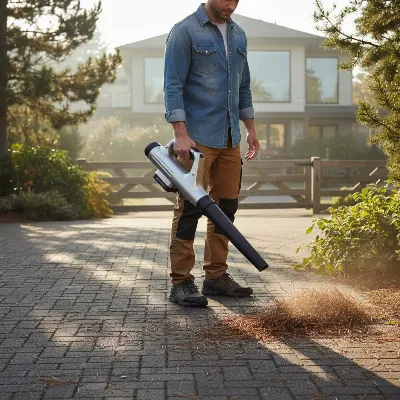 A person using a battery-powered leaf blower to clear pine needles from a driveway, showcasing ease of use.
Guide to Using and Maintaining Your Leaf Blower
Proper use and regular maintenance are crucial for maximizing the effectiveness and extending the lifespan of your heavy-duty leaf blower, especially when tackling abrasive materials like pine needles.
For safe operation, always wear appropriate personal protective equipment, including ear protection, eye protection, and sturdy gloves. Pine needles can be thrown at high speeds, and gas blowers produce significant noise. When operating, use a sweeping motion, working from the outer edges of the area inward to form piles. For pine needles, aim the nozzle at a low, forward angle to effectively dislodge them from surfaces without scattering them excessively. Blowing with the wind rather than against it will significantly reduce effort and improve efficiency.
Maintenance varies by power source:
- Gas Blowers: Regularly check and clean or replace air filters, spark plugs, and fuel filters. Use the correct fuel-to-oil mixture and store with a fuel stabilizer to prevent carburetor issues.
- Battery Blowers: Keep batteries charged and stored in a cool, dry place. Avoid fully draining or overcharging for optimal battery health. Clean the blower after each use, ensuring no debris is lodged in the fan or air intake.
- All Types: Periodically inspect nozzles for wear and tear, and ensure all connections are secure. A clean machine runs more efficiently and lasts longer.
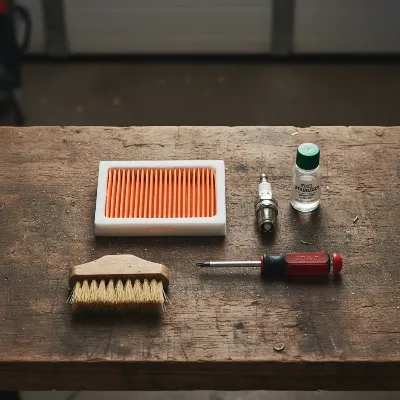 Essential tools for leaf blower maintenance, including an air filter, spark plug, and fuel stabilizer.
Environmental Considerations for Leaf Blower Use
While leaf blowers are invaluable for maintaining outdoor spaces, their use carries environmental implications that responsible operators should consider.
Noise Pollution: Gas-powered leaf blowers are a significant source of noise pollution, operating at decibel levels that can be disruptive to residential communities and potentially harmful to operators without proper hearing protection. Opting for quieter electric or battery-powered models can drastically reduce this impact.
Air Quality: Gas leaf blowers emit pollutants such as carbon monoxide, hydrocarbons, and nitrogen oxides, contributing to smog and air quality issues. These emissions are particularly relevant when operating in enclosed or poorly ventilated areas. Battery-powered and corded electric blowers produce zero direct emissions, making them a more environmentally friendly choice.
Debris Management: Instead of simply blowing leaves and pine needles to the curb, consider methods of responsible disposal. Mulching attachments can reduce debris volume for composting or bagging, turning yard waste into a valuable soil amendment. Collecting leaves and needles for local composting programs can also divert waste from landfills. By adopting mindful practices, we can harness the efficiency of leaf blowers while minimizing their ecological footprint.
Conclusion
Choosing the ideal heavy-duty leaf blower for persistent pine needles means prioritizing raw power, ergonomic design, and suitability for your specific property. From the unmatched force of gas-powered titans like the Echo PB-9010T and Husqvarna 360BT to the impressive, eco-conscious performance of battery models such as the Ego Power+ LB7654 and Enhulk 58V 930 CFM, a perfect balance of high CFM and MPH is essential to effectively clear dense, stubborn debris. Always remember to consider your yard size, the nature of your debris, and the critical balance of power, weight, and noise to select a tool that will not only simplify your cleanup but also last for years to come.
What unique challenges do pine needles present in your yard, and how has your choice of leaf blower helped you overcome them?
Frequently Asked Questions
What CFM and MPH are ideal for blowing pine needles?
For effectively moving stubborn pine needles, which are often wet and dense, look for a heavy-duty leaf blower with at least 800 CFM (Cubic Feet per Minute) and 200 MPH (Miles Per Hour). A balance between high air volume (CFM) and high air speed (MPH) ensures both the capability to gather large quantities and the force to dislodge compacted needles.
Are battery leaf blowers powerful enough for heavy-duty pine needles?
Yes, modern battery-powered leaf blowers, particularly high-voltage models (e.g., 56V, 60V, 80V) with strong CFM and MPH ratings (e.g., 700+ CFM, 180+ MPH), are increasingly powerful enough to handle heavy-duty tasks like clearing pine needles. While they might have limited runtime compared to gas models, their performance has significantly improved.
Why are backpack leaf blowers often recommended for pine needles?
Backpack leaf blowers are recommended for pine needles because they typically offer superior power (high CFM and MPH) and engine displacement compared to handheld models, which is crucial for moving heavy, matted debris. Their design also distributes the weight across your back, providing greater comfort and reducing fatigue during extended use over large areas.
Do leaf blowers with vacuum/mulching features work well for pine needles?
While many leaf blowers offer vacuum and mulching capabilities, their effectiveness for pine needles can vary. Pine needles are tough and can clog some mulching mechanisms. Dedicated heavy-duty blowers are primarily focused on blowing power. If mulching is a priority, look for models with strong metal impellers designed to handle robust debris.
How does noise level factor into choosing a leaf blower for pine needles?
Noise level is an important factor, especially in residential areas with noise restrictions. Gas leaf blowers are significantly louder (often 90-100 dB) than electric or battery models. If operating in noise-sensitive environments, a powerful battery-powered blower with lower decibel ratings would be a more considerate choice, although ear protection is still recommended for any heavy-duty use.
Get our weekly buyer guide
Practical specs, not advice. Unsubscribe anytime.
