The best backpack leaf blowers for conquering heavy wet leaves combine high Cubic Feet per Minute (CFM) for volume and high Miles Per Hour (MPH) for dislodging stubborn debris. Models like the Stihl BR 800 C-E Magnum and Husqvarna 580BTS Mark II offer superior power and robust design, making them indispensable for homeowners with large properties and professionals alike. These tools transform the daunting task of clearing heavy, damp leaf piles into an efficient and manageable process.
When vibrant autumn leaves turn into heavy, wet piles clinging stubbornly to your lawn, traditional rakes and handheld blowers often prove insufficient. This guide explores what makes a backpack blower effective against heavy wet leaves, examining different types, key features, and top models to help you find the perfect partner for your yard maintenance needs.
Overview of Backpack Leaf Blowers
A backpack leaf blower is a robust outdoor power tool designed to efficiently clear leaves, grass clippings, and other yard debris from large areas. Unlike handheld models, which are suitable for lighter tasks, backpack blowers feature a larger engine or motor housed within a frame that is worn comfortably on the user’s back, distributing the weight across the shoulders and hips. This ergonomic design allows for prolonged use without significant arm fatigue, making them ideal for extensive landscapes and commercial applications. For expert leaf blower reviews on this site.
The evolution of leaf blowers has seen significant advancements, moving from basic handheld models to the powerful backpack units we know today. Early versions were often bulky and inefficient, but continuous innovation has led to lighter designs, more powerful engines, and improved user comfort. Today, backpack blowers are categorized primarily by their power source: gas, electric (corded), and battery-powered. While corded electric backpack blowers are less common, gas and battery-powered models dominate the market, each offering distinct advantages tailored to different user needs and environmental considerations.
Classifying Leaf Blowers by Power Source
The power source of a leaf blower significantly impacts its performance, mobility, and environmental footprint. Understanding these differences is crucial when selecting a machine capable of handling heavy wet leaves.
Gas-Powered Backpack Leaf Blowers
Gas-powered backpack leaf blowers are renowned for their raw power and mobility, making them the preferred choice for large properties and professional landscapers. These machines feature potent two-stroke or four-stroke engines that deliver exceptional air volume (CFM) and air speed (MPH), which are critical for dislodging and moving heavy, wet, and compacted leaves. Their ability to operate without being tethered to an outlet provides unrestricted movement across vast areas.
However, gas blowers come with certain trade-offs. They are generally louder, produce exhaust emissions, and require regular maintenance, including fuel mixing (for two-stroke engines) and oil changes (for four-stroke). Their weight is also typically higher than battery-powered alternatives. Despite these considerations, for those requiring maximum clearing power and extended runtimes in challenging conditions, a gas-powered unit remains an industry standard.
Battery-Powered Backpack Leaf Blowers
Battery-powered backpack leaf blowers represent a growing segment, offering a compelling blend of power, convenience, and environmental benefits. These units run on rechargeable lithium-ion batteries, eliminating the need for gasoline, oil, and power cords. They are significantly quieter than gas models, produce zero direct emissions, and are generally lighter, making them easier on the user and more suitable for noise-sensitive residential areas. Starting a battery blower is as simple as pressing a button, a stark contrast to the pull-cord start of gas models.
The primary limitations of battery-powered blowers have historically been run-time and peak power. However, advancements in battery technology are rapidly closing this gap, with high-voltage systems (e.g., 40V, 80V) delivering power levels that rival many mid-range gas blowers. While they may still require multiple batteries for very large tasks or continuous professional use, their quiet operation and ease of use make them an excellent choice for medium to large yards and those prioritizing an eco-friendlier approach.
Detailed Comparison of Leaf Blower Types
Choosing the ideal backpack leaf blower for your needs, especially when facing heavy wet leaves, often comes down to balancing power, convenience, and environmental considerations. Here’s a comparative look at the primary types:
| Feature | Gas-Powered Backpack Blower | Battery-Powered Backpack Blower |
|---|---|---|
| Power Output | Highest CFM/MPH, best for heavy, wet, or compacted debris | Good to excellent CFM/MPH, rapidly improving for tough jobs |
| Mobility | Unlimited, no cords, ideal for large areas | Unlimited within battery charge, no cords |
| Weight | Generally heavier (20-30+ lbs) | Lighter (often 10-25 lbs, depending on battery size) |
| Noise Level | Loudest (typically 70-80+ dB), often requires hearing protection | Quietest (often under 65 dB), neighborhood-friendly |
| Emissions | Produces exhaust fumes | Zero direct emissions |
| Run-time | Long, limited only by fuel capacity | Limited by battery charge (15-60+ mins per battery) |
| Maintenance | More complex (fuel, oil, spark plugs, filters) | Low (battery charging, occasional cleaning) |
| Start-up | Pull-cord start, can be challenging | Instant push-button start |
| Cost | Mid to high-range for the unit itself | Higher upfront cost (unit + batteries/charger) |
| Ideal Use | Large properties, commercial landscaping, heavy debris, wet leaves | Medium to large yards, noise-sensitive areas, regular cleanups |
This comparison highlights that gas blowers often deliver maximum power and sustained run-time for the toughest jobs. In contrast, battery models excel in user-friendliness, lower noise, and environmental impact, with power levels increasingly capable of handling substantial tasks.
Important Criteria When Choosing a Leaf Blower
Selecting the right backpack leaf blower involves more than just picking the most powerful model. It requires a thoughtful assessment of your specific needs and the features that will best address them, especially when battling heavy wet leaves.
Defining Your Usage Needs
Before diving into specifications, consider the scope of your work. How large is the area you need to clear? For expansive properties (over half an acre), a high-powered gas or commercial-grade battery blower is often necessary. What type of debris will you typically encounter? If heavy wet leaves, matted debris, or even light snow are common, you’ll need a machine with significant force. Finally, how often will you use the blower? Frequent, prolonged use warrants a durable, comfortable, and efficient model.
Engine Power and Airflow Metrics
The true muscle of a leaf blower is measured by its airflow metrics: Cubic Feet per Minute (CFM) and Miles Per Hour (MPH).
- CFM (Cubic Feet per Minute): This measures the volume of air the blower moves. Higher CFM is crucial for moving large quantities of leaves quickly, especially when dealing with expansive piles. For clearing substantial areas, look for models with 600 CFM and above.
- MPH (Miles Per Hour): This indicates the speed or force of the air as it exits the nozzle. High MPH is vital for dislodging stubborn, wet, or compacted leaves that cling to surfaces. For effectively tackling wet debris, an MPH rating of 180-250 MPH is highly desirable.
For heavy wet leaves, a balanced combination of high CFM and high MPH is paramount. High MPH provides the initial blast to break up sticky piles, while high CFM ensures you can move that large volume of dislodged debris efficiently across your property.
Weight and Ergonomic Design
Even the most powerful blower is ineffective if it causes excessive fatigue. Backpack leaf blowers range in weight, typically from 15 to over 30 pounds. Look for models with an ergonomic design, including padded shoulder straps, a comfortable backrest, and an adjustable hip belt. These features distribute the weight evenly across your body, reducing strain during extended operation. An anti-vibration system is also a significant benefit, minimizing the vibrations transferred from the engine to your body. Consider whether a hip-mounted or tube-mounted throttle control is more comfortable and offers better maneuverability for your working style.
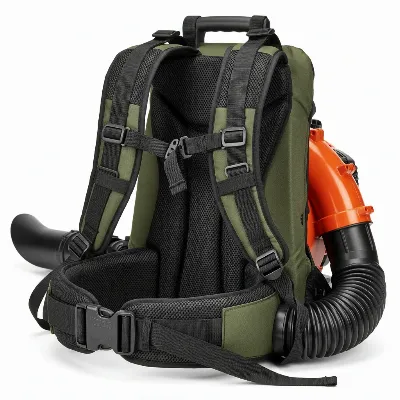 Ergonomic backpack leaf blower with padded straps and hip belt for user comfort
Noise Levels
Noise pollution is a common concern with leaf blowers, particularly gas-powered models. Manufacturers provide decibel (dB) ratings, often measured at the operator’s ear or at 50 feet. If you operate in residential areas or for extended periods, consider models with lower dB ratings or those explicitly labeled “Whisper Series.” Battery-powered blowers are generally much quieter than their gas counterparts, making them an excellent choice for noise-sensitive environments. Always wear hearing protection, regardless of the blower’s noise rating.
Additional Features
Modern backpack leaf blowers often come with features that enhance convenience and versatility:
- Variable Speed Control: Allows you to adjust airflow strength for different tasks, from delicate flowerbeds to heavy leaf piles.
- Cruise Control: Locks in a specific throttle setting, reducing hand fatigue during long jobs.
- Nozzle Attachments: Flat nozzles are excellent for sweeping large areas, while round nozzles concentrate air for blasting stubborn, wet debris or cleaning crevices.
- Vacuum/Mulching Capability: Some blowers can convert into vacuums to collect leaves, which are then shredded for composting. This is less common in high-powered backpack models but can be a useful secondary function for lighter debris.
- Easy Start System: Features like spring-assisted starting or electronic ignition make gas blowers easier to crank.
Brand Reputation and Pricing
Investing in a reputable brand often means better build quality, reliable performance, and access to customer support and spare parts. Top brands in the leaf blower market include Stihl, Husqvarna, Echo, Greenworks, EGO, and Ryobi. While price is always a factor, remember that a higher upfront cost for a durable, high-performance model may lead to greater satisfaction and a longer lifespan, offering better value in the long run. Compare features and prices across different brands to find a product that fits both your budget and your performance expectations.
Top Backpack Leaf Blowers for Heavy Wet Leaves
When tackling stubborn, heavy wet leaves, certain backpack leaf blowers consistently rise to the occasion due to their superior power, robust design, and user-friendly features. Here are some of the top picks known for their exceptional performance in challenging conditions.
1. Stihl BR 800 C-E Magnum / BR 800 X MAGNUM
The Stihl BR 800 series is a professional-grade powerhouse, widely regarded for its immense blowing force. With a large 79.9 cc engine, it delivers high CFM (around 912 CFM) and impressive MPH (up to 239 MPH), making it incredibly effective at clearing heavy piles of wet leaves, sticks, and other stubborn debris. Key features include a side-mounted starting mechanism that allows for restarts without removing the blower, and an advanced anti-vibration system for enhanced comfort during extended use. While on the heavier side (around 25.8 lbs) and premium-priced, its unmatched power and durability make it a top choice for professionals and homeowners with vast properties.
2. Husqvarna 580BTS Mark II
The Husqvarna 580BTS Mark II is another high-performance gas-powered backpack blower designed for demanding tasks. It boasts a powerful engine capable of producing around 1,000 CFM and 206 MPH, easily handling large volumes of wet leaves and heavy debris. Husqvarna’s X-Torq® engine technology reduces emissions and improves fuel efficiency. The ergonomic harness system with padded straps and hip belt ensures comfort during long working hours. It’s a robust option for those needing serious power and reliability.
3. Echo PB-9010T
Echo’s PB-9010T is hailed as one of the most powerful backpack blowers available, often referred to as a “windstorm” by users. Its 79.9 cc engine delivers an astonishing 1110 CFM and 220 MPH, making short work of massive leaf piles, including heavy wet ones. The “T” in its model name signifies a tube-mounted throttle, offering excellent control and maneuverability, even in confined spaces. Despite its immense power, it maintains a comfortable design with a robust frame, though its weight (around 26.7 lbs) is typical for this class of machine. This model is a favorite for those who prioritize maximum power output.
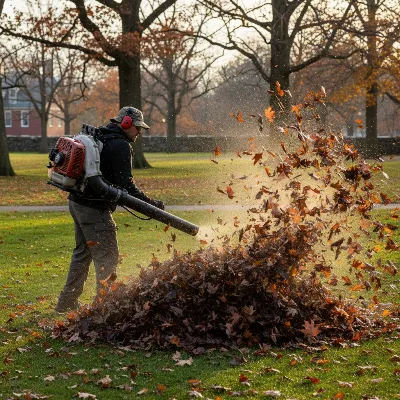 Gas-powered backpack leaf blower efficiently clearing wet leaves from a large lawn
4. Greenworks Commercial BB361 (and newer models)
For those seeking robust battery power, the Greenworks Commercial BB361 is a standout. It offers a blowing force of 36 Newtons (and newer models are pushing 40-50 Newtons), capable of outperforming many entry and mid-range gas blowers. It combines the benefits of zero emissions, quieter operation, and less maintenance with serious clearing power. While battery run-time still requires consideration (and potentially multiple batteries for very large jobs), its performance against wet leaves is highly commendable. The advancements in Greenworks’ battery technology make these models increasingly competitive for heavy-duty tasks where gas alternatives were once the only option.
5. Husqvarna 360BT
The Husqvarna 360BT offers commercial-grade power at a more accessible price point. Its 65.6 cc 2-cycle engine provides ample air volume (890 CFM) and high wind speed (232 MPH), making it effective for clearing larger properties and clumps of wet leaves. At 23 pounds, it strikes a good balance between power and manageable weight, with generous padding on the backrest, shoulder straps, and hip belt to ensure a comfortable carry during extended use. It’s a solid overall choice for homeowners who need significant power without breaking the bank.
These top picks demonstrate that whether you prefer the raw, continuous power of gas or the quieter, emission-free operation of advanced battery technology, there are excellent backpack leaf blowers available to handle even the heaviest and wettest of leaf challenges.
Operating and Maintaining Your Backpack Leaf Blower
Proper use and regular maintenance are essential for maximizing the performance and extending the lifespan of your backpack leaf blower, especially when it’s frequently used against heavy wet leaves.
Safe Operation Guidelines
Safety should always be your top priority when operating any power tool.
- Read the Manual: Always familiarize yourself with your specific blower’s owner’s manual for detailed operating instructions and safety precautions.
- Wear Protective Gear: Essential PPE includes hearing protection (earplugs or earmuffs), eye protection (safety glasses or goggles), long pants, closed-toe shoes, and gloves.
- Check Your Surroundings: Before starting, ensure no people, pets, or delicate objects are in the blowing path. Be mindful of loose debris that could become projectiles.
- Proper Stance: Maintain a stable footing. When wearing a backpack blower, ensure the harness is adjusted snugly for optimal weight distribution and comfort.
- Avoid Wet Surfaces: While designed for wet leaves, be cautious on extremely slippery surfaces. Also, avoid directing air at puddles or standing water, as this can splash debris.
- Fueling (Gas Models): Refuel in a well-ventilated area away from open flames. Allow the engine to cool before refueling.
- Battery Charging (Battery Models): Use only the manufacturer-approved charger and battery. Do not charge in extremely hot or cold conditions.
Routine Maintenance for Longevity
Consistent maintenance will keep your blower running efficiently and prevent costly repairs.
- Clean After Each Use: Remove any leaves, dirt, or debris from the air intake, fan housing, and nozzle. For gas models, clean the cooling fins to prevent overheating.
- Air Filter (Gas Models): Check and clean the air filter regularly, especially after use in dusty conditions. Replace it if it’s damaged or excessively dirty. A clogged air filter can significantly reduce power.
- Spark Plug (Gas Models): Inspect the spark plug annually. Clean or replace it as needed to ensure reliable starting and efficient combustion.
- Fuel System (Gas Models): Use fresh, high-quality fuel. If storing for an extended period (over 30 days), drain the fuel tank or use a fuel stabilizer to prevent gumming in the carburetor.
- Battery Care (Battery Models): Store batteries in a cool, dry place. Avoid fully discharging lithium-ion batteries and charge them periodically during off-season storage.
- Nozzle and Tube Inspection: Check for cracks, blockages, or wear in the blower tube and nozzle. Replace damaged parts to maintain optimal airflow.
- Harness and Straps: Inspect the harness, straps, and buckles for wear or damage. Proper adjustment ensures comfort and safety.
- Professional Servicing: Consider an annual tune-up by a qualified technician, especially for gas models, to ensure all components are in top working order.
Common Issues and Troubleshooting
- Loss of Power: Could be a clogged air filter, old fuel, a dirty spark plug (gas), or a low battery charge (battery).
- Difficulty Starting: Often related to stale fuel, a dirty spark plug, or a flooded engine (gas). For battery models, ensure the battery is charged and properly seated.
- Excessive Vibration: May indicate a loose component, damaged fan, or worn anti-vibration mounts.
- Overheating (Gas Models): Usually caused by clogged cooling fins or an incorrect fuel mixture.
Addressing these issues promptly can prevent minor problems from escalating into major repairs, ensuring your leaf blower is always ready for the next pile of wet leaves.
Environmental Considerations for Leaf Blower Use
While highly effective, the use of leaf blowers, particularly gas-powered models, has raised environmental concerns regarding air quality and noise pollution. Responsible operation can help mitigate these impacts.
Using leaf blowers judiciously is key to minimizing noise and air pollution. Restrict use to appropriate times of day and consider the impact on neighbors. For areas with frequent leaf fall, planning your cleanup efficiently can reduce operating time. Furthermore, properly disposing of collected leaves is important. Instead of bagging them for landfills, consider composting them, using them as mulch for garden beds, or creating leaf mold. These methods enrich soil and reduce waste.
Opting for eco-friendly leaf blower options, such as battery-powered models, is another significant step. These emit zero direct exhaust fumes, reducing carbon footprint and improving local air quality. They also operate at significantly lower noise levels, making them more community-friendly. As battery technology continues to advance, the power and run-time of electric blowers are increasingly capable of handling tasks traditionally reserved for gas models, offering a compelling green alternative for effective yard maintenance.
Conclusion
Navigating the challenges of heavy wet leaves requires a powerful and reliable tool, and the best backpack leaf blowers are specifically designed for this demanding task. By understanding the critical roles of high CFM for volume and high MPH for dislodging stubborn debris, you can make an informed decision tailored to your property’s needs. Whether you choose the raw power and extended run-time of a gas-powered model or the quieter, emission-free operation of an advanced battery-powered unit, prioritizing comfort, durability, and essential features will ensure your investment serves you well.
Ultimately, the right backpack leaf blower transforms the arduous chore of clearing heavy wet leaves into an efficient and manageable process. By considering your specific requirements, exploring top models like the Stihl BR 800 C-E Magnum or the Husqvarna 580BTS, and committing to responsible usage and maintenance, you’ll be well-equipped to keep your property pristine throughout the year. What is the biggest challenge you face when clearing heavy wet leaves, and how might a powerful backpack blower help you overcome it?
Frequently Asked Questions
What CFM and MPH are best for wet leaves?
For wet leaves, look for a backpack leaf blower with a high CFM (600-1000+) to move large volumes and a high MPH (180-250+) to effectively dislodge stubborn, heavy debris. A balanced combination of both is crucial for optimal performance.
Are battery backpack blowers powerful enough for wet leaves?
Yes, modern battery-powered backpack blowers, especially high-voltage commercial-grade models, are increasingly powerful enough to handle wet leaves. While some top gas models might still offer more sustained power, battery technology has advanced significantly, making them a viable and often preferred option for many users.
How often should I perform maintenance on my gas backpack leaf blower?
Routine maintenance like cleaning the air filter and checking fuel should be done after every few uses or before each significant job. A more thorough annual tune-up, including spark plug inspection and fuel system checks, is recommended to ensure longevity and peak performance.
What is the average weight of a backpack leaf blower?
Most backpack leaf blowers weigh between 15 to 30 pounds. Gas models tend to be on the heavier side due to their engines and fuel tanks, while battery-powered units are generally lighter, though large capacity batteries can add significant weight.
Can I use a backpack leaf blower for light snow?
Many powerful backpack leaf blowers with high CFM and MPH ratings can effectively clear light, fluffy snow, similar to how they handle dry leaves. However, they are not designed for heavy, wet, or compacted snow and should not be used as a substitute for a snowblower in those conditions.
Frequently Asked Questions
What CFM and MPH ratings are ideal for clearing wet leaves?
For wet leaves, an ideal backpack leaf blower should have a high CFM of 600-1000+ to move large volumes and an MPH of 180-250+ to dislodge stubborn, heavy debris. A balanced combination of both metrics ensures optimal clearing performance.
Can battery-powered backpack blowers effectively handle wet leaves?
Yes, modern battery-powered backpack blowers, especially high-voltage commercial-grade models, are increasingly powerful enough for wet leaves. While some top gas models may offer more sustained power, advancements in battery technology make them a viable and often preferred option for many users due to their quieter operation and zero emissions.
How often should I perform maintenance on a gas backpack leaf blower?
Routine maintenance, such as cleaning the air filter and checking fuel, should be performed after every few uses or before each significant job. An annual tune-up, including spark plug inspection and fuel system checks, is recommended to ensure longevity and peak performance for gas models.
What is the typical weight range for backpack leaf blowers?
Most backpack leaf blowers weigh between 15 to 30 pounds. Gas models tend to be heavier due to their engines and fuel tanks, while battery-powered units are generally lighter, although large-capacity batteries can add significant weight to the overall unit.
Are backpack leaf blowers suitable for clearing light snow?
Many powerful backpack leaf blowers with high CFM and MPH ratings can effectively clear light, fluffy snow, similar to how they handle dry leaves. However, they are not designed for heavy, wet, or compacted snow and should not be used as a substitute for a dedicated snowblower in those conditions.
How to Choose the Best Backpack Leaf Blower
Selecting the right backpack leaf blower for heavy wet leaves involves assessing your property size, debris type, and desired features like power, comfort, and noise levels.
Consider the size of your property (e.g., over half an acre may require a high-powered gas or commercial-grade battery blower) and the type of debris you'll encounter. Frequent, prolonged use warrants a durable, comfortable, and efficient model.
Look for a balanced combination of high CFM (Cubic Feet per Minute) for volume and high MPH (Miles Per Hour) for force. For heavy wet leaves, aim for 600+ CFM and 180-250 MPH to effectively dislodge and move debris.
Choose a model with padded shoulder straps, a comfortable backrest, and an adjustable hip belt to distribute weight evenly and reduce fatigue. An anti-vibration system and comfortable throttle control are also beneficial for extended use.
If operating in residential areas, opt for models with lower decibel ratings or battery-powered units. Look for features like variable speed control, cruise control, and nozzle attachments for enhanced versatility and convenience.
Invest in a reputable brand like Stihl, Husqvarna, or Echo for better build quality and reliable performance. Compare features and prices across different brands to find a product that fits both your budget and performance expectations for long-term value.
Get our weekly buyer guide
Practical specs, not advice. Unsubscribe anytime.

This guide was spot on about needing both high CFM and MPH. I used to dread clearing my driveway after a rain, but my new blower (a different model, but with similar specs to the ones discussed) just blasts through everything. It’s truly transformed my fall cleanup routine.
I finally broke down and got a backpack blower after years of struggling with a handheld. The Stihl BR 800 C-E Magnum mentioned here is an absolute beast. It made quick work of the heavy, wet oak leaves that usually take me hours. Definitely worth the investment for anyone with a large property.
I picked up a different brand of backpack blower after reading about the importance of high MPH for stubborn debris. While it does a decent job on dry leaves, it struggles a bit with the really heavy, wet ones like the guide talked about. I probably should have splurged for one of the top models.
I’ve been using the Husqvarna 580BTS Mark II for about a month now, and it’s fantastic for clearing my large yard. The high CFM really helps move those damp piles. My only minor complaint is that it’s a bit heavier than I expected, but the power makes up for it.