The best budget leaf blowers under $100 for 2026 are typically corded electric models like the Toro 51624 PowerJet F700 (750 CFM) and Worx WG520 Turbine 600 (600 CFM), or versatile 3-in-1 options such as the Toro 51621 UltraPlus Blower Vac. These models offer robust performance for clearing leaves and debris in residential yards without a significant financial investment, making yard cleanup faster and less physically demanding than manual raking.
Overview of Leaf Blowers
A leaf blower is an essential yard tool designed to clear leaves, grass clippings, dirt, and other light debris by generating a strong stream of air. Initially conceived as a more efficient alternative to rakes, these powerful devices have evolved significantly, making yard cleanup faster and less physically demanding. From small residential properties to larger commercial landscapes, leaf blowers offer a versatile solution for maintaining cleanliness and curb appeal.
The evolution of the leaf blower reflects a consistent drive towards greater efficiency and user comfort. Early models were often heavy and gas-powered, demanding significant maintenance and producing considerable noise. Today, advancements in technology have led to a wider variety of options, including lightweight electric and battery-powered models that are quieter, easier to operate, and more environmentally friendly, making them accessible to a broader range of users.
Classifying Leaf Blowers by Power Source
The type of power source fundamentally dictates a leaf blower’s performance characteristics, mobility, and environmental impact. Understanding these distinctions is crucial, especially when looking for the best value within a $100 budget.
Electric Leaf Blowers (Corded)
Corded electric leaf blowers are a popular choice for budget-conscious homeowners due to their consistent power and lower upfront cost. These models typically plug directly into an outdoor electrical outlet, providing unlimited run time as long as they remain connected.
- Pros: They are generally lighter than gas models, easy to start with a push of a button, produce less noise, and are emission-free, making them environmentally friendly. Their consistent power output ensures effective debris clearing for extended periods without needing to refuel or recharge.
- Cons: The main drawback is their reliance on an electrical cord, which limits mobility to the length of the cord and any extension cords used. This can be inconvenient for larger yards or areas without readily available outlets.
- Applications: Corded electric blowers are ideal for small to medium-sized yards, patios, driveways, and other areas where a power outlet is easily accessible. They excel at routine cleanups of dry leaves and light debris.
Battery-Powered Leaf Blowers (Cordless)
Battery-powered leaf blowers offer the convenience of cordless operation, combining many benefits of electric models with enhanced mobility. While historically more expensive, several reliable options are now available closer to the $100 mark, often as tool-only versions or with smaller battery packs.
- Pros: The primary advantage is their superior portability, allowing users to move freely without being tethered to an outlet. They are significantly quieter than gas blowers, produce zero emissions, and require minimal maintenance. Starting is typically instant with a simple button press.
- Cons: The main limitation is battery run time, which can range from 15 to 30 minutes on a single charge, depending on the model and power setting. Recharging takes time, and spare batteries can be an additional cost. The power output, while continuously improving, might not match the sustained strength of higher-end corded or gas models for heavy-duty tasks.
- Applications: These blowers are perfect for quick clean-ups, smaller yards, and areas where corded access is difficult, such as garden beds or distant corners of the property.
 A person using a lightweight cordless leaf blower to clear leaves from a small garden path.
Gas Leaf Blowers
While generally outside the under-$100 budget for new purchases, gas leaf blowers are known for their raw power and complete portability. They represent the most robust option for demanding tasks.
- Pros: Gas models offer the highest power output and unlimited mobility, making them suitable for very large properties and heavy-duty debris, including wet leaves and small sticks.
- Cons: They are significantly noisier, produce exhaust emissions, require fuel mixing and more frequent maintenance (spark plugs, air filters), and are typically heavier. For budget buyers, new gas models are almost always priced well above $100.
- Applications: Primarily used for large professional landscapes or extensive residential properties where maximum power and run time are critical, and budget is less of a constraint.
Detailed Comparison of Leaf Blowers
When selecting a budget leaf blower, a quick comparison helps highlight the strengths and weaknesses of popular types available within the under-$100 price range. While gas blowers are generally excluded from this budget, electric (corded) and entry-level battery-powered models offer excellent value.
| Feature | Corded Electric Leaf Blower | Battery-Powered Leaf Blower (Budget) |
|---|---|---|
| Power Source | Plugs into outlet (120V) | Rechargeable Lithium-ion battery |
| CFM/MPH | Generally 200-400 CFM, 150-250 MPH; consistent power | Varies, often 100-300 CFM, 90-150 MPH; power can drop with battery |
| Weight | Very lightweight (3-7 lbs) | Lightweight (3-8 lbs, including battery) |
| Noise Level | Low to moderate (65-75 dB) | Low to moderate (60-75 dB) |
| Run Time | Unlimited (as long as plugged in) | Limited (15-30 minutes on average) |
| Mobility | Restricted by cord length | Excellent (fully cordless) |
| Maintenance | Very low (occasional cleaning) | Low (battery charging, occasional cleaning) |
| Initial Cost | Very affordable (often $40-$80) | Affordable for tool-only, battery/charger may push over $100 |
| Pros | Consistent power, lightweight, no emissions, low cost | Portable, no emissions, quick start, relatively quiet |
| Cons | Cord limitations, less powerful for wet debris | Limited run time, battery/charger often sold separately |
For many homeowners, the greatest value comes from understanding that the ‘best’ leaf blower isn’t always the most expensive, but the one that perfectly matches their specific yard size and cleaning habits without overspending.
Key Criteria When Choosing a Leaf Blower
Selecting the right budget leaf blower involves more than just looking at the price tag. Several important factors should guide your decision to ensure you get a tool that meets your needs effectively.
Determine Your Usage Needs
Before diving into specifications, consider how you intend to use the leaf blower.
- Area Size: For small patios, driveways, or compact urban yards, a lightweight, less powerful corded electric or small battery-powered model is often sufficient. For larger residential yards, you might need something with more CFM and potentially a longer cord or an extra battery if going cordless.
- Type of Debris: Dry, light leaves and grass clippings are easily handled by most budget blowers. If you frequently deal with wet, matted leaves, small twigs, or heavier debris, you’ll need a model with higher CFM.
- Frequency of Use: If you’ll be using it weekly, prioritize ergonomics and a reliable motor. For occasional seasonal cleanups, a simpler, more basic model will suffice.
Machine Power (CFM vs. MPH)
When evaluating a leaf blower’s power, two key metrics are crucial: CFM and MPH.
- CFM (Cubic Feet per Minute): This indicates the volume of air the blower moves per minute. Higher CFM means the blower can move larger piles of leaves or clear wider areas more efficiently. For example, a model with 750 CFM is excellent for heavy-duty tasks like moving wet leaves.
- MPH (Miles Per Hour): This refers to the speed at which the air exits the nozzle. Higher MPH helps dislodge stubborn, wet leaves or move heavy debris with a concentrated force.
- Choosing the Right Balance: For general residential use, prioritize CFM, as it dictates how much work the blower can do. A good balance of high CFM and decent MPH is ideal for most tasks.
Weight and Ergonomics
A lightweight and ergonomically designed leaf blower will significantly enhance user comfort and reduce fatigue, especially during longer cleanup sessions.
- Weight: Budget models are typically handheld and range from 3 to 8 pounds. Lighter models are easier to maneuver and hold, which is crucial for comfort if you have a larger area to clear or plan to use it for extended periods.
- Ergonomics: Look for features like comfortable grips, balanced designs that don’t strain your wrist, and easy-to-reach controls. Some models offer variable speed triggers, allowing you to adjust power without stopping.
Noise Level
Leaf blowers can be noisy, which is a concern for both the user and neighbors. Manufacturers usually list noise levels in decibels (dB).
- Standards: Many municipalities have noise ordinances, so it’s wise to check local regulations. Generally, electric and battery-powered models are quieter than gas alternatives.
- Choosing Quieter Models: Look for models with lower dB ratings, ideally below 70-75 dB for a more pleasant operating experience. While some budget models might still be a bit loud, they are generally less disruptive than their gas counterparts.
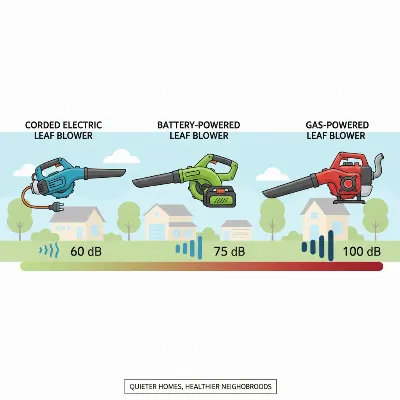 An infographic comparing noise levels of different types of leaf blowers in a suburban neighborhood.
Additional Features
Some budget leaf blowers come with extra features that can add significant value and versatility.
- Vacuum and Mulcher Functions: Certain models can switch between blowing and vacuuming, allowing you to collect leaves into a bag and often mulch them, reducing their volume. The Toro 51621 UltraPlus Blower Vac and Black + Decker 3-in-1 BV6000 are examples of this versatility.
- Variable Speed Control: This feature allows you to adjust the airflow for different tasks, from gently clearing delicate flowerbeds to blasting stubborn piles of wet leaves.
- Nozzle Types: Some blowers include different nozzles (e.g., concentrated for stubborn debris, wide for general clearing) that can enhance performance.
Brand and Price
While sticking to a budget under $100, reliable brands offer good quality and performance.
- Reputable Brands: Brands like Toro, Worx, Sun Joe, Black+Decker, and Greenworks frequently offer models in the budget category that provide dependable performance and often have decent customer support and warranty options.
- Value for Money: Focus on the best combination of power, features, and durability within your price range. Sometimes, spending a little closer to the $100 limit can significantly improve the overall user experience and product longevity.
Top Budget Leaf Blowers Under $100 for 2026
Finding a powerful and reliable leaf blower for under $100 might seem challenging, but several excellent options provide exceptional value and performance for the price. Here are some of the top picks for 2026 that balance affordability with effectiveness.
Toro 51624 PowerJet F700 Handheld Leaf Blower
The Toro 51624 PowerJet F700 is a standout corded electric leaf blower consistently recommended for its impressive power-to-price ratio. It’s designed for those who need serious clearing ability on a budget.
- Pros: This model boasts a remarkable 750 CFM airflow, one of the highest on the market for its price point, making it incredibly effective at tackling large piles of wet, heavy leaves. Its super-powered motor ensures it performs on par with higher-end models. It is lightweight, making it comfortable for one-handed use, and its durable construction suggests a long lifespan.
- Cons: As a corded model, its range is limited by the length of your extension cord. It can also be quite loud during operation.
- Specs: Corded Electric, 750 CFM.
- Why it’s a top pick: Its unmatched CFM for the price makes it an unbeatable choice for clearing significant leaf accumulation, even in damp conditions.
__SC0__
Worx WG520 Turbine 600 Electric Leaf Blower
The Worx WG520 Turbine 600 is another highly-rated corded electric leaf blower known for its powerful air volume and user-friendly design. It’s often praised for its ability to clear tough debris.
- Pros: The Worx WG520 is exceptionally powerful and designed to clear leaves off any surface from a distance, including wet, matted leaves. It is lightweight and easy to use, providing great performance for its $79.98 price point. The turbine technology contributes to its high volume of air movement.
- Cons: Similar to other corded models, its mobility is restricted by the need for an extension cord. It is also noted for being loud.
- Specs: Corded Electric, 600 CFM.
- Why it’s a top pick: It offers immense power and effective clearing capabilities for wet leaves, making it a robust option for general yard maintenance.
__SC1__
Toro 51621 UltraPlus Blower Vac
For those who need more than just blowing, the Toro 51621 UltraPlus provides excellent versatility as a 3-in-1 tool, often found right at the $99 mark.
- Pros: This versatile corded electric model functions as a blower, a vacuum, and a leaf shredder (mulcher). It offers user-friendly controls and a robust design, allowing you to not only clear leaves but also collect and reduce their volume for easier disposal. It’s ideal for thorough yard cleanup.
- Cons: While versatile, switching between modes can take a moment. Like all corded units, it requires an electrical outlet and extension cord.
- Specs: Corded Electric, 3-in-1 (Blower, Vacuum, Mulcher), often around 250 MPH.
- Why it’s a top pick: Its multifunctionality offers incredible value, allowing you to tackle a wider range of yard tasks with a single, affordable tool.
__SC2__
Sun Joe SBJ597E Electric Leaf Blower
The Sun Joe SBJ597E is a testament to the fact that good things can come in small, inexpensive packages. It’s an excellent choice for targeted cleaning and small areas.
- Pros: This corded electric blower is lightweight, compact, and very inexpensive, making it a “best value” pick for homeowners with minimal cleanup needs. It excels at clearing precise areas quickly, like patios, decks, and small pathways.
- Cons: It typically features only one air speed setting, which limits its versatility. It can be quite loud despite its small size. It is not designed for heavy-duty or wet leaf tasks.
- Specs: Corded Electric, Lightweight.
- Why it’s a top pick: For homeowners needing a basic, reliable, and highly affordable blower for light, quick tasks, the Sun Joe SBJ597E delivers without unnecessary frills.
__SC3__
How to Use and Maintain Your Leaf Blower
Proper usage and regular maintenance are key to maximizing the lifespan and efficiency of your budget leaf blower.
Safe Usage Guidelines
Always prioritize safety when operating any power tool.
- Read the Manual: Familiarize yourself with your specific model’s instructions and safety warnings.
- Wear Protective Gear: Always wear safety glasses or goggles to protect your eyes from flying debris. Ear protection is highly recommended, especially with louder models. Long pants and closed-toe shoes are also advised.
- Check Your Surroundings: Before starting, ensure no people, pets, or fragile objects are in the path of the airflow. Be mindful of where debris will be blown to avoid creating new messes or bothering neighbors.
- Manage the Cord (for electric models): If using a corded blower, ensure the extension cord is rated for outdoor use and is long enough to cover your area without being stretched taut. Keep the cord behind you to prevent tripping or cutting it.
- Avoid Wet Surfaces: Do not use electric or battery-powered blowers in rain or extremely wet conditions to prevent electrical hazards.
Routine Maintenance for Electric and Battery Models
Budget leaf blowers, particularly electric and battery ones, require minimal maintenance but consistent care will ensure optimal performance.
- Clean After Each Use: Disconnect from power (or remove battery) and wipe down the exterior of the blower, removing any dust, dirt, or debris that may have accumulated. Ensure the air intake vents are clear.
- Check for Obstructions: Periodically inspect the blower tube and fan (impeller) for any lodged debris that could impede airflow or damage the motor.
- Store Properly: Store your leaf blower in a dry, covered area away from extreme temperatures. For battery-powered models, store the battery in a cool, dry place and follow manufacturer guidelines for charging and long-term storage (e.g., storing at a partial charge).
- Inspect Cords/Batteries: Regularly check power cords for fraying or damage. For battery models, inspect the battery pack for any signs of damage or leakage.
Common Issues and Basic Troubleshooting
- Blower Not Starting: Ensure the unit is properly plugged in (corded) or the battery is fully charged and correctly inserted (battery-powered). Check for any safety interlocks or power switches that might not be engaged.
- Reduced Airflow: This is often due to an obstruction in the blower tube or air intake. Disconnect power/remove battery and clear any blockages.
- Overheating: If the motor feels excessively hot, stop using the blower immediately, disconnect power/remove battery, and allow it to cool down. Ensure air vents are clear to prevent future overheating.
Environmental Considerations for Leaf Blower Use
As an environmentally conscious user, you can minimize the impact of your leaf blower while still enjoying a clean yard.
- Mindful Operation: Use your leaf blower strategically to minimize noise and dust. Operate it during reasonable hours, avoiding early mornings or late evenings, and direct debris away from neighbors’ properties.
- Leaf Collection and Disposal: Instead of blowing leaves into the street where they can clog storm drains, aim to collect them. Consider using a blower with a vacuum/mulcher function to reduce leaf volume for composting or bagging. Composting leaves enriches your garden soil naturally.
- Embrace Eco-Friendly Models: Choosing electric or battery-powered leaf blowers significantly reduces your carbon footprint as they produce zero direct emissions, contributing to cleaner air quality in your neighborhood.
 A family using a quiet electric leaf blower to mulch leaves in their garden, surrounded by green trees and compost bins.
Conclusion
Finding the best budget leaf blower under $100 in 2026 is entirely achievable, with many robust and efficient options available. Whether you prioritize consistent power with a corded electric model like the Toro 51624 PowerJet F700 or Worx WG520 Turbine 600, or seek the added versatility of a 3-in-1 system like the Toro 51621 UltraPlus, there’s a solution that fits your needs and your wallet. By considering your yard size, the types of debris you typically encounter, and key features like CFM and ergonomics, you can confidently select a leaf blower that simplifies your yard work.
Choosing a budget-friendly leaf blower empowers you to maintain a pristine outdoor space without the financial strain often associated with quality power tools. What kind of yard cleanup tasks are you hoping to make easier with your new leaf blower?
Frequently Asked Questions
Are cheap leaf blowers worth it?
Absolutely, many budget leaf blowers under $100 offer excellent value for money, especially for residential use. They are perfectly capable of handling dry leaves, grass clippings, and light debris on small to medium-sized yards, making them a worthwhile investment to save time and effort compared to manual raking.
What should I look for in a leaf blower under $100?
When buying a leaf blower under $100, prioritize its power (CFM for air volume), weight for comfortable handling, and a power source (corded electric for unlimited runtime or a budget-friendly battery model for portability). Consider models with good user reviews and basic features relevant to your tasks, like variable speed if available.
What’s the difference between CFM and MPH in leaf blowers?
CFM (Cubic Feet per Minute) measures the volume of air a leaf blower moves, indicating how large a pile of leaves it can clear. MPH (Miles Per Hour) measures the speed of the air, which indicates how well it can dislodge stubborn or wet debris. For most general yard work, a higher CFM is often more beneficial as it helps clear larger areas more quickly.
How do corded electric leaf blowers compare to battery-powered ones?
Corded electric leaf blowers offer unlimited run time and consistent power, ideal for small to medium yards with accessible outlets. Battery-powered models provide superior portability and zero emissions but have limited run times (typically 15-30 minutes) and may require separate battery/charger purchases.
What are the best brands for budget leaf blowers?
Reputable brands like Toro, Worx, Sun Joe, Black+Decker, and Greenworks frequently offer reliable leaf blower models in the under-$100 budget category. These brands often provide dependable performance, good customer support, and warranty options.
Can I use a budget leaf blower for wet leaves?
While most budget leaf blowers are best for dry, light debris, models with higher CFM, such as the Toro 51624 PowerJet F700 (750 CFM) or Worx WG520 Turbine 600 (600 CFM), can effectively tackle wet, matted leaves. Prioritize CFM when dealing with heavier, damp debris.
Frequently Asked Questions
Are cheap leaf blowers worth it?
Absolutely, many budget leaf blowers under $100 offer excellent value for money, especially for residential use. They are perfectly capable of handling dry leaves, grass clippings, and light debris on small to medium-sized yards, making them a worthwhile investment to save time and effort compared to manual raking.
What should I look for in a leaf blower under $100?
When buying a leaf blower under $100, prioritize its power (CFM for air volume), weight for comfortable handling, and a power source (corded electric for unlimited runtime or a budget-friendly battery model for portability). Consider models with good user reviews and basic features relevant to your tasks, like variable speed if available.
What's the difference between CFM and MPH in leaf blowers?
CFM (Cubic Feet per Minute) measures the volume of air a leaf blower moves, indicating how large a pile of leaves it can clear. MPH (Miles Per Hour) measures the speed of the air, which indicates how well it can dislodge stubborn or wet debris. For most general yard work, a higher CFM is often more beneficial as it helps clear larger areas more quickly.
How do corded electric leaf blowers compare to battery-powered ones?
Corded electric leaf blowers offer unlimited run time and consistent power, ideal for small to medium yards with accessible outlets. Battery-powered models provide superior portability and zero emissions but have limited run times (typically 15-30 minutes) and may require separate battery/charger purchases.
What are the best brands for budget leaf blowers?
Reputable brands like Toro, Worx, Sun Joe, Black+Decker, and Greenworks frequently offer reliable leaf blower models in the under-$100 budget category. These brands often provide dependable performance, good customer support, and warranty options.
Can I use a budget leaf blower for wet leaves?
While most budget leaf blowers are best for dry, light debris, models with higher CFM, such as the Toro 51624 PowerJet F700 (750 CFM) or Worx WG520 Turbine 600 (600 CFM), can effectively tackle wet, matted leaves. Prioritize CFM when dealing with heavier, damp debris.
How to Use and Maintain Your Budget Leaf Blower
Proper usage and routine maintenance are crucial for maximizing the lifespan and efficiency of your budget leaf blower, ensuring it performs optimally for years.
Always read your specific model's manual and safety warnings before use. Wear protective gear, including safety glasses or goggles and ear protection, to shield yourself from flying debris and noise. Ensure your surroundings are clear of people, pets, and fragile objects before starting.
For corded electric models, use an outdoor-rated extension cord long enough for your area, keeping it behind you to prevent tripping or cutting. Never use electric or battery-powered blowers in rain or extremely wet conditions to avoid electrical hazards. This prevents damage to the tool and ensures user safety.
Disconnect the blower from power or remove the battery after each use. Wipe down the exterior to remove dust, dirt, and debris, and ensure air intake vents are clear. This simple step prevents buildup and maintains optimal airflow.
Periodically check the blower tube and fan for any lodged debris that could impede airflow or damage the motor. Store your leaf blower in a dry, covered area away from extreme temperatures. For battery models, store the battery in a cool, dry place, following manufacturer guidelines for charging and long-term storage.
If the blower doesn't start, ensure it's properly plugged in or the battery is charged and inserted correctly. Reduced airflow often indicates an obstruction in the tube or intake, which should be cleared after disconnecting power. If the motor overheats, stop use immediately, disconnect power, and allow it to cool down, ensuring vents are clear.
Get our weekly buyer guide
Practical specs, not advice. Unsubscribe anytime.

I got the Toro 51621 UltraPlus Blower Vac because I liked the idea of a 3-in-1, but the vacuum function isn’t quite as powerful as I hoped. It’s great for blowing, and the mulching feature is decent for dry leaves. Just wish it had a bit more oomph when sucking up damp debris. Still, for the price, it’s a good value.
The Worx WG520 Turbine 600 has been a solid performer for me. It’s lightweight and the 600 CFM is plenty for my average-sized suburban yard. I appreciate that it’s a corded electric model, so I don’t have to worry about gas or batteries. It makes quick work of all the grass clippings after mowing.
This post helped me decide on a corded electric model, and I’m so glad I did. My old gas blower was such a hassle to start. Now, I just plug it in and go. It’s made my weekly leaf clearing so much faster and less of a chore. Definitely recommend going electric for residential use.
I picked up the Toro 51624 PowerJet F700 after reading about it here, and wow, it’s a game-changer for my small yard. The 750 CFM really moves those wet leaves without any trouble. For under $100, you really can’t beat the power and ease of use. My back is definitely thanking me for ditching the rake!