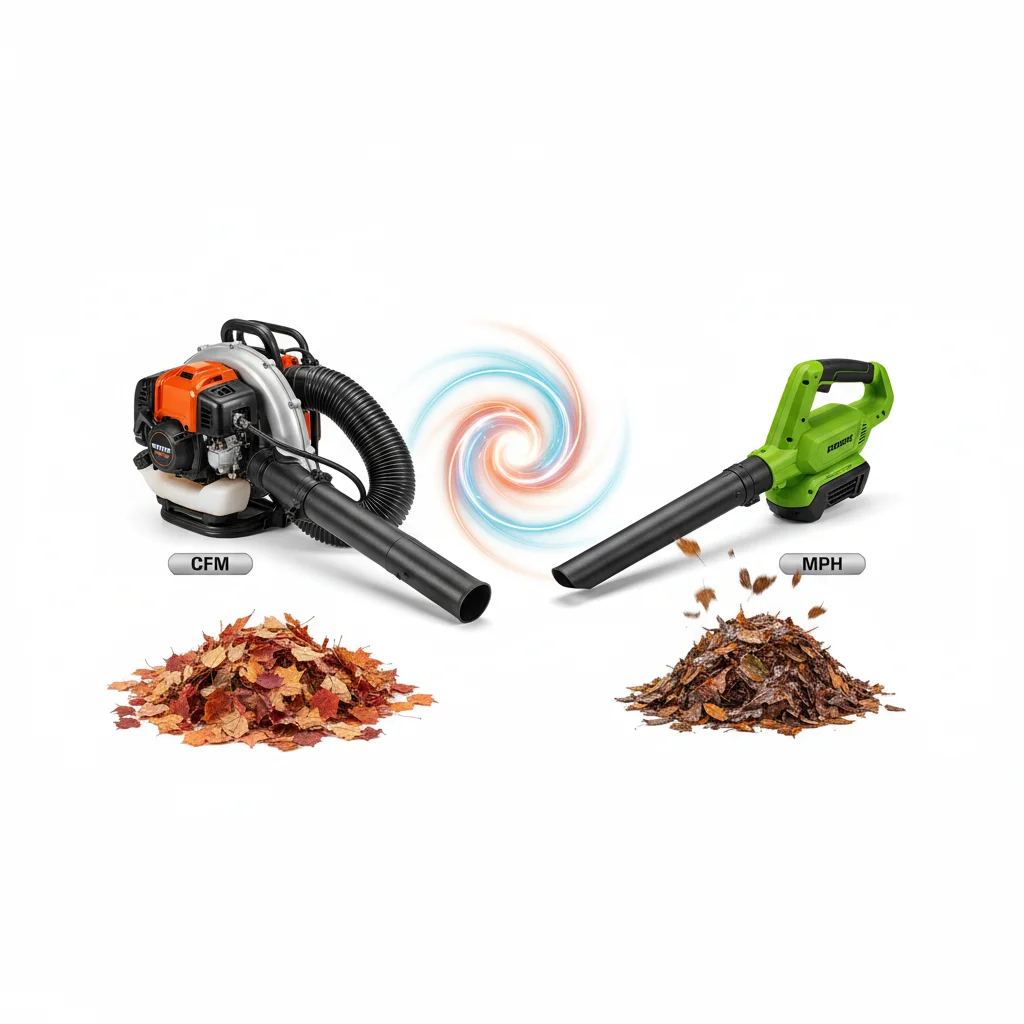
When evaluating leaf blowers, understanding the difference between CFM (Cubic Feet per Minute) and MPH (Miles Per Hour) is crucial for making an informed decision. While both metrics describe aspects of a leaf blower’s performance, CFM indicates the volume of air moved, directly correlating to how much debris can be cleared at once, whereas MPH measures the speed of the air exiting the nozzle, which impacts the force applied to the debris. For most users, CFM is the more critical metric as it directly relates to the efficiency and speed of clearing larger areas and heavier piles of leaves.
Understanding CFM: The Volume Advantage
CFM, or Cubic Feet per Minute, quantifies the volume of air a leaf blower can move in one minute. A higher CFM rating means the blower can move a greater quantity of leaves and debris with each pass. This is particularly important for clearing large areas, tackling wet leaves, or moving substantial piles of yard waste. Think of CFM as the ‘width’ of the air stream; a wider stream can push more material simultaneously, making your cleanup faster and more efficient. For example, a blower with 600 CFM will clear a wider path of leaves than one with 300 CFM, even if their MPH ratings are similar.
Understanding MPH: The Force Factor
MPH, or Miles Per Hour, measures the speed at which air exits the leaf blower’s nozzle. A higher MPH rating indicates a more concentrated and forceful blast of air. This force is beneficial for dislodging stubborn, stuck-on debris, such as wet leaves matted to concrete, small pebbles, or compacted dirt. While a high MPH can be impressive, without sufficient CFM, it might only move a small amount of debris very quickly, requiring more passes to clear a large area. Consider MPH as the ‘punch’ of the air stream; it’s great for targeted, powerful blasts.
The Synergy of CFM and MPH: Finding the Right Balance
|
Our Picks for the Best Leaf Blower in 2026
As an Amazon Associate I earn from qualifying purchases.
|
||
| Num | Product | Action |
|---|---|---|
| 1 | DEWALT 20V MAX Blower, 100 CFM Airflow, Variable Speed Switch, Includes Trigger Lock, Bare Tool Only (DCE100B) |

|
| 2 | MZK Cordless Leaf Blower,20V Battery Powered Electric Blower for Lawn Care, Electric Lightweight Leaf Blower for Blowing Leaves, Patio Cleaning and Dust(2 * 2Ah Battery & Charger Included),LF40D13 |
|
| 3 | WORX Cordless Leaf Blower, Electric Blower with Turbine Fan, Blowers for Lawn Care with 2 Speed Control, Battery & Charger Included, WG547 |
|
| 4 | 20V Handheld Electric Cordless Leaf Blower with 2.0Ah Battery & Fast Charger, Powerful up to 93 MPH, 350 CFM Stepless Speed Control, Powerful for Yard Cleaning |
|
| 5 | WORX 12 Amp Electric Leaf Blower, Turbine Blower for Lawn Care with 600 CFM & 2 Speed Control, Corded, WG520 |
|
| 6 | BLACK + DECKER Electric Leaf Blower, Hand Held Blowers for Lawn Care, Up to 450 CFM and 140 MPH Power, Axial, Lightweight, Corded (BEBL750) |
|
| 7 | Electric Leaf Blower Cordless, 21V Battery Powered Blower with 2 x 4.0Ah Battery and Charge, 715CFM &180MPH and 3 Speed Mode, Brushless Handheld Blowers for Lawn Care, Yard, Leaves, Dust, Snow |
|
| 8 | BLACK+DECKER Electric Leaf Blower, Handheld Blowers for Lawn Care, Lightweight, 180 MPH 180 CFM, 7-Amp, Corded (LB700) |
|
| 9 | 6-Speed Modes Cordless Leaf Blower 21V,200MPH High-Velocity Electric Blower,Lightweight for Dry/Wet Leaves,Lawn Debris,Garage and Driveway Cleaning,Red |
|
| 10 | EGO POWER+ Leaf Blower, Cordless Electric 530 CFM, Battery and Charger Not Included - LB5300 |
|
The most effective leaf blowers often strike a good balance between CFM and MPH. A high CFM allows you to move a large volume of material, while a respectable MPH provides the necessary force to dislodge it. For general yard work, a blower with a higher CFM (e.g., 400-700 CFM) is generally more versatile and efficient. However, if your primary need is to clear heavy, wet debris or dislodge items from cracks, a blower with a higher MPH (e.g., 150-200+ MPH) in combination with a decent CFM might be more suitable. Always consider the type of debris and the size of your yard when evaluating these specifications.
- Small Yards/Light Debris: Look for 200-400 CFM and 100-150 MPH.
- Medium Yards/General Use: Aim for 400-600 CFM and 150-180 MPH.
- Large Yards/Heavy Debris: Prioritize 600+ CFM and 180+ MPH.
- Professional Use: Seek 700+ CFM and 200+ MPH for maximum efficiency.
Nozzle Design and Its Impact on Performance
It’s important to note that nozzle design significantly influences how CFM and MPH translate into real-world performance. A wider, flared nozzle will typically emphasize CFM, spreading the air over a larger area, which is excellent for general clearing. Conversely, a narrower, concentrated nozzle will boost MPH, creating a more powerful, focused stream ideal for stubborn debris. Some leaf blowers come with interchangeable nozzles, allowing you to optimize performance for different tasks. Always check if the advertised CFM and MPH ratings are measured with a standard or specific nozzle type, as this can affect comparisons.
Ultimately, while MPH provides a measure of air speed and force, CFM is generally the more important metric for overall leaf blower efficiency, especially for clearing large volumes of debris. A higher CFM rating will allow you to complete tasks faster and with fewer passes. When shopping, consider your specific needs and look for a balance that suits your typical yard work. For a powerful and versatile option, consider the, which offers an excellent blend of both metrics. If you need something with extreme force for tough jobs, theis a top contender.
Get our weekly buyer guide
Practical specs, not advice. Unsubscribe anytime.
